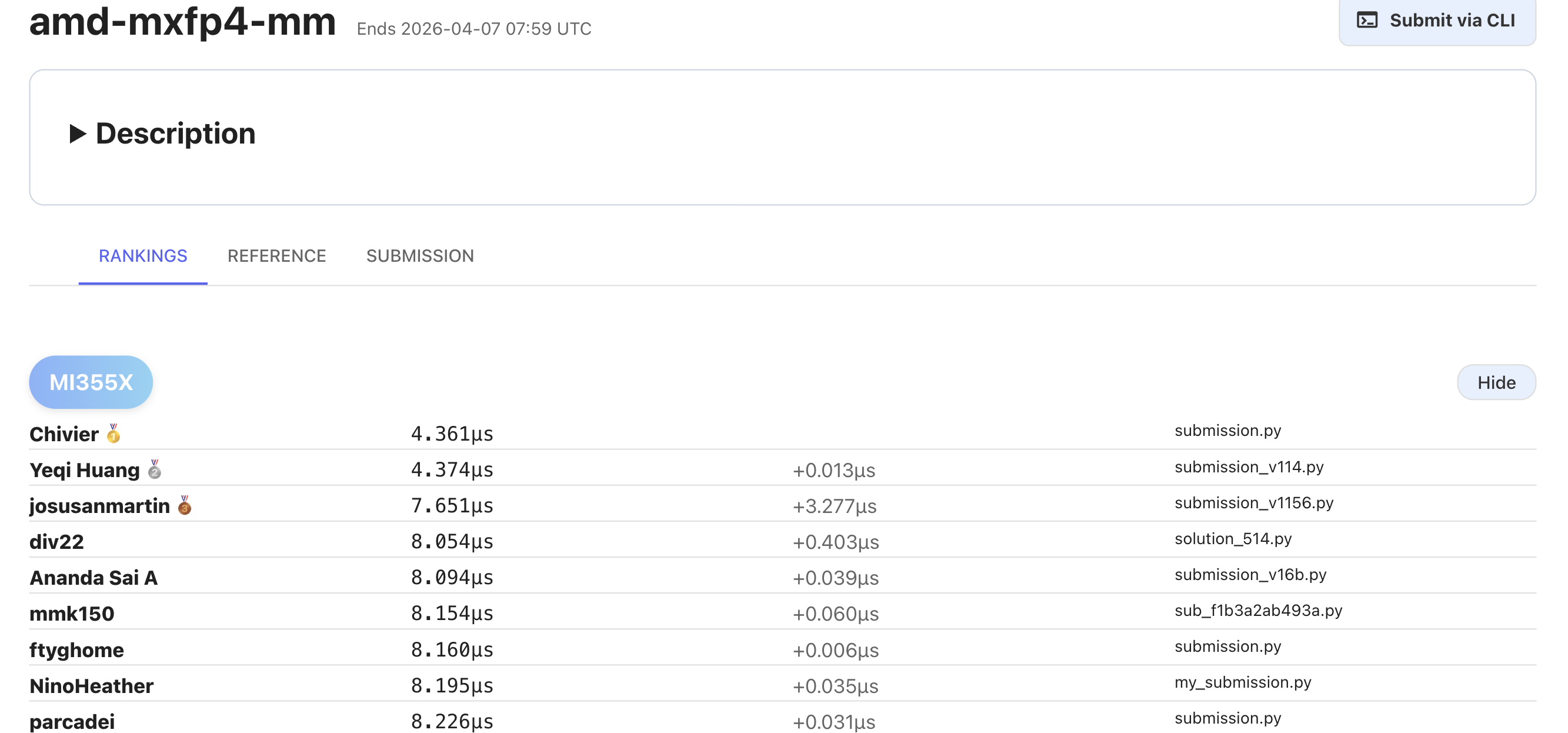
Saber AI placed first and second on the MI355X leaderboard in the AMD MXFP4-MM Hackathon. The top submissions shown in the ranking were 4.361us by Chivier and 4.374us by Yeqi Huang.
This result is another example of a capability we care about deeply: adapting AI workloads to new hardware fast. The best AI systems are not only about model quality. They also depend on understanding the execution environment, memory layout, kernels, compilers, interconnects, and the real constraints of the target accelerator.
Our team has produced strong results across NVIDIA, Cerebras, Tenstorrent, and AMD hardware. That breadth matters for clients and partners because AI infrastructure is changing quickly. A system that works well on one platform often needs careful redesign to run efficiently on another.
For Saber AI, new hardware adaptation is part of the same end-to-end delivery loop we use in production projects: understand the workload, profile the bottleneck, redesign the kernel or system path, validate performance, and turn the result into software that users can actually run.
Saber AI 在 AMD MXFP4-MM Hackathon 的 MI355X 榜单中获得第一和第二。截图中的前两名分别是 Chivier 的 4.361us 和 Yeqi Huang 的 4.374us。
这个结果体现了我们非常重视的一项能力:快速把 AI 工作负载适配到新硬件。优秀的 AI 系统不只取决于模型本身,还取决于对执行环境、内存布局、kernel、编译器、互连方式和目标加速器约束的理解。
我们的团队在 NVIDIA、Cerebras、Tenstorrent 和 AMD 硬件上都有很好的结果。这种广度对客户和合作伙伴很重要,因为 AI 基础设施变化很快;一个系统在某个平台上表现好,迁移到另一个平台时往往需要重新设计和优化。
对 Saber AI 来说,新硬件适配是端到端交付能力的一部分:理解工作负载,定位瓶颈,重写 kernel 或系统路径,验证性能,并把结果变成用户真正可以运行的软件。